
Table of Contents
- 🧭 Why scammers call when the market is sideways
- ⚙️ The A-B-C-M framework I use for entries
- 📊 Zonal updates, buyer zones, and why angle matters
- 📈 Seeing momentum: money flow and the 93% example
- 🧾 Practical trade management: entry, targets, and the U-turn exit
- 📉 When you see quick pumps and what they mean
- 🪙 Case study: Gold trade and micro lot sizing
- 🛡️ How to protect yourself from tip-sellers and noisy signals
- 🔧 Why in-house coding matters
- 🧰 Quick checklist before pressing enter
- 🔑 Keywords for search and learning
- ❓ Frequently Asked Questions
- 🧠 Final thoughts: trade with a system, not emotions
🧭 Why scammers call when the market is sideways
Scammers love noise. When the market is range bound or sideways, tip-sellers and cold callers increase their calls because it is easier to create the illusion of a “sure thing” when price action lacks a clear trend. If you get more calls offering tips, consider that a market signal: the underlying action is likely sideways, not trending.
Two simple takeaways:
- Fewer tip calls = trending market. When the market has a clear direction, scammy tip calls drop dramatically.
- More tip calls = range-bound market. Beware of high-promise tips during choppy sessions. They leverage uncertainty to sell confidence.
⚙️ The A-B-C-M framework I use for entries
There’s a compact, repeatable checklist that helps filter setups. We call it the A-B-C-M rule:
- A — Angle: Is a meaningful angle forming in the preferred direction? Angle helps identify structural momentum.
- B — Breakout: Has price cleared a local level or zone that validates the angle?
- C — Candle: Are the candles confirming movement (size, momentum, follow-through)?
- M — Money flow: Is the money flow line moving in the same direction as price? This confirms participation.
When all four line up, the trade has higher probability. The system also shows a percentage confidence metric. When the algorithm flags a trade with high percentage (we often see numbers like 90%+), holding calmly and following the exit rule becomes easier.
📊 Zonal updates, buyer zones, and why angle matters
Labels and zones simplify decision-making. Instead of guessing where support and resistance lie, zonal updates mark buyer and seller regions based on code-driven parameters. The angle is not just an aesthetic. It is a geometric expression of price momentum.
Different angles communicate different intensities. A shallow angle means slow momentum. A steep angle means strong momentum. Watch how the angle progresses relative to a reference line (we use a yellow reference line). When angle forms above that reference, you get a bias. When it turns, you act.
📈 Seeing momentum: money flow and the 93% example
One powerful confirmation is money flow. If price is rising and the money flow line is green and pointing upward, it means money is moving into the instrument. Combine that with an angle and breakout and you have momentum. In one session a trade printed a 93% confidence — a sequence of angle, breakout, candle structure, and money flow alignment. Those trades usually travel smoothly and are easier to manage.

🧾 Practical trade management: entry, targets, and the U-turn exit
Trading is not just about getting in. It is about knowing where to exit and when to take profits. Here’s the rule I consistently follow:
- Enter when A-B-C-M align.
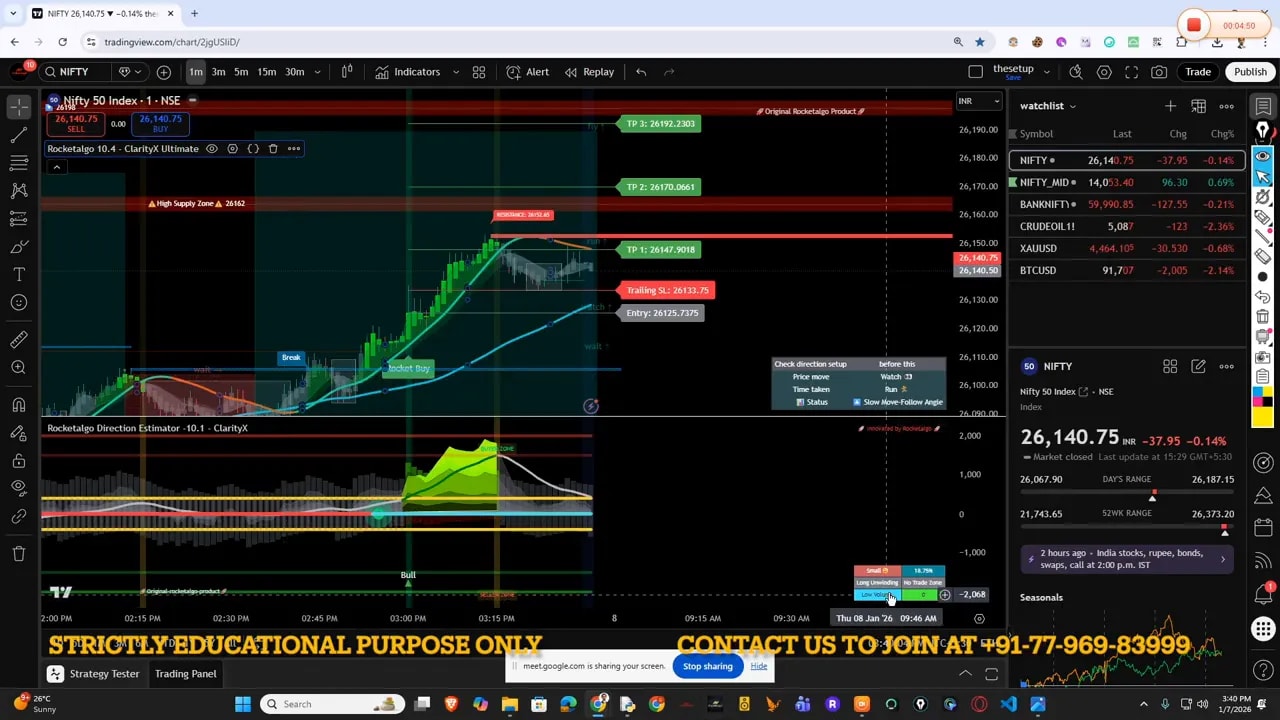
- Set the first target near the first coded resistance line.
- Observe: if price hits that resistance and makes a U-turn, take profits at or before that level. If the trade remains strong, the angle will continue upward and you can trail your exit.
- If the angle turns (U-turn) before reaching first resistance, book the first target and re-evaluate.
These coded resistance lines are not arbitrary. They are tested levels that tell you where profit booking often occurs. If the trade fails to get through the first resistance, it usually gives you a clean exit at that point. If it blasts through, the angle and money flow will show continued strength and you can hold for the next leg.
📉 When you see quick pumps and what they mean
If price suddenly breaks out with excessive momentum (a pump), be cautious. A very aggressive pump that ejects price outside the coded zones often ends with sharp reversion. In simpler terms: big pumps can be followed by big U-turns. Use the angle and money flow to decide whether to hold through a pump or lock in gains.

🪙 Case study: Gold trade and micro lot sizing
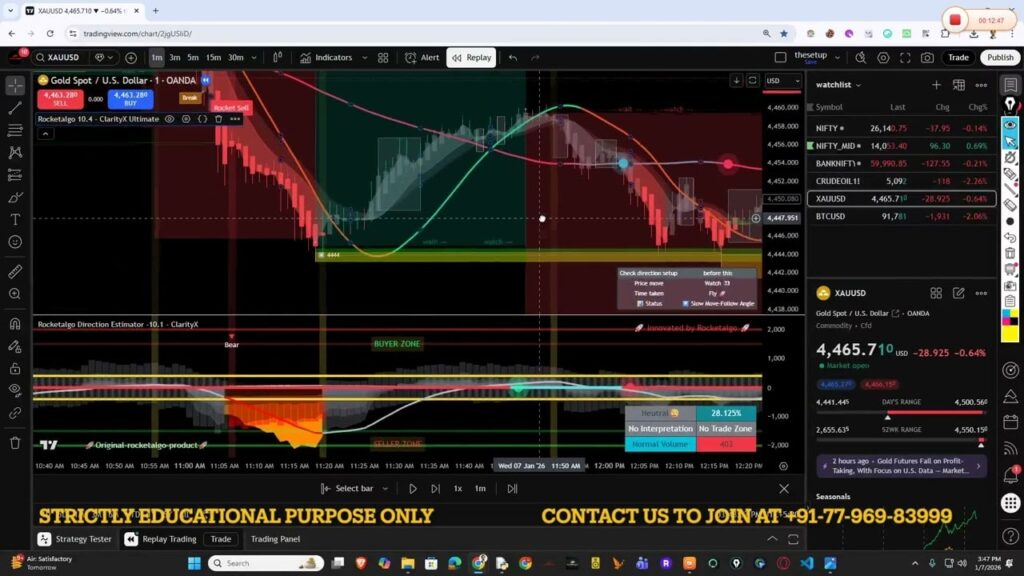
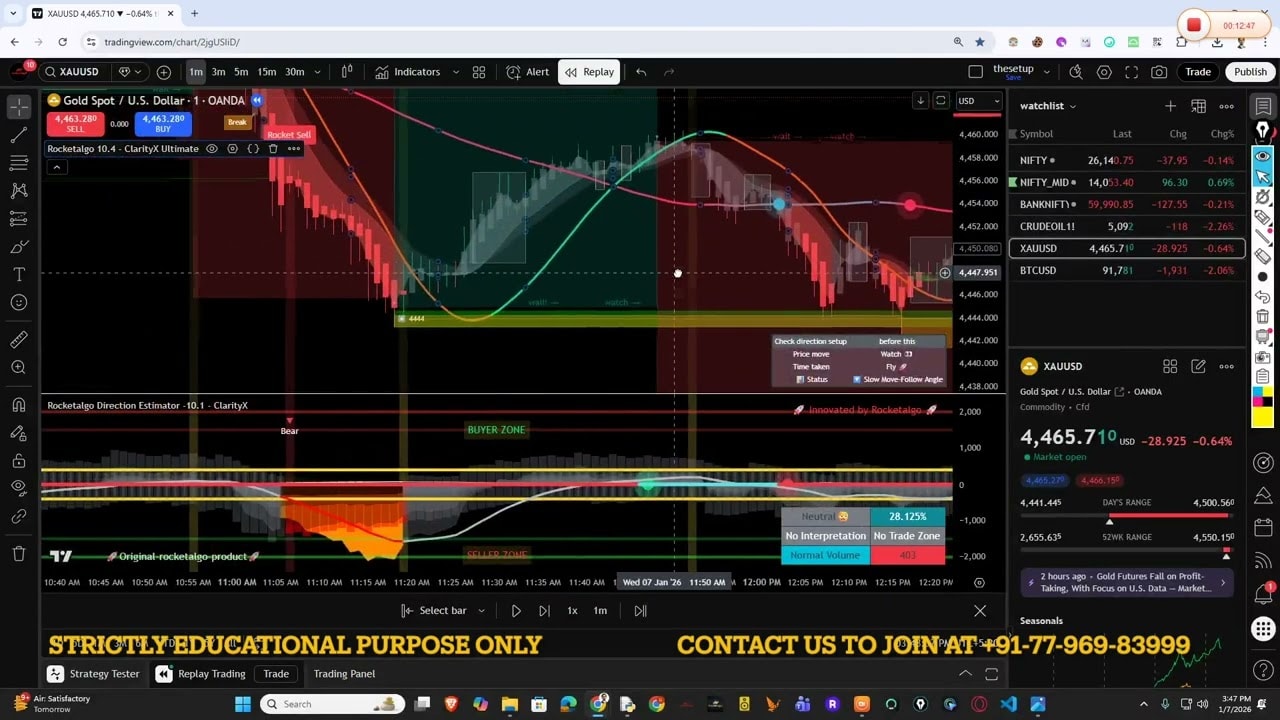
Example: a downtrend in gold showed a reversal setup. One trader entered around 4455.8 and quickly captured a few dollars per contract. To translate P&L into real terms, remember:
- Micro lot moves = small dollar value per tick (for practice or low-risk trades).
- Mini lot and full lot scale up the dollar gains and losses.
Small wins stack. That trade gave immediate momentum and then hit a support where angle turned and profit booking happened as per the rules.

🛡️ How to protect yourself from tip-sellers and noisy signals
Market behavior gives you clues. Use them.
- Listen to call volume: more tip calls usually mean more sideways action. Use that as a signal to tighten risk and be selective.
- Filter setups: only take trades where A-B-C-M align.
- Set first target and stop: don’t be greedy. Most trades will give a clean first-target exit if they’re weak.
🔧 Why in-house coding matters
Generic teaching often leaves out the specifics because the edge is in the details. When you codify processes like angle detection, zonal updates, and money flow alignment, you remove subjectivity. That is why in-house indicators and tested code reduce mistakes and help you stick to disciplined trading rules.
There is no magic. It is about engineering consistent signals and aligning them with risk management.
🧰 Quick checklist before pressing enter
- Angle confirmed in the trading direction.
- Breakout through a local level or buyer zone.
- Candle confirmation (size, follow-through, no immediate reversal candle).
- Money flow line moving in the same direction and preferably turning green on buys.
- Percentage confidence above your predefined threshold (for many this is 70%+).
- Defined first target and stop-loss mapped to coded zones.
🔑 Keywords for search and learning
Keywords: trading, stock market, NSE, BSE, Nifty, intraday strategy, algo trading, money flow, breakout strategy, profit booking, zonal levels.
❓ Frequently Asked Questions
How can I tell if the market is sideways or trending?
If you receive many tip calls and noise from “advisors,” the market is often sideways or range bound. Trending markets attract fewer tip calls. Use price structure and angle formation as confirmation.
What is the A-B-C-M rule and why is it reliable?
A-B-C-M stands for Angle, Breakout, Candle, Money flow. It combines geometry, price action, candle confirmation, and participation. When all four align, probability improves because you have structure, trigger, confirmation, and volume bias.
When should I book profits?
Book profits when the coded resistance zone is encountered and the angle turns (U-turn). If the trade shows weakness before the first resistance, take the first target. If it stays strong and clears resistance with money flow confirmation, trail profits to capture more.
Can I rely on indicators alone?
Indicators help, but they should be used with a ruleset. Coding in-house indicators reduces subjectivity, but you still need risk management, entry criteria, and exit rules. Indicators amplify discipline; they do not replace it.
How do I size position for intraday trades?
Position sizing should match your risk tolerance. Use micro or mini lots while practicing. Understand the dollar value per tick for each instrument so you can set stops that keep losses within acceptable limits.
🧠 Final thoughts: trade with a system, not emotions
Trading on the NSE, BSE, Nifty, or any market becomes easier when you use repeatable rules. The combination of zonal maps, angle detection, breakout confirmation, candle structure, and money flow is a practical toolkit you can test and adopt.
Trust the process. When a trade hits your rules, follow the checklist. When the angle turns, act. When the coded resistance appears, respect it. And when the market is full of tip-sellers, remember that noise is often the best signal of an uncertain market.
Consistency beats overnight success. Build systems, code the repetitive parts, and use disciplined exits. That is how small, consistent wins become a sustainable edge in the trading, stock market, NSE, BSE, Nifty world.
Need more help |
|
Contact us by clicking the button below |
| Click me |

