

If you trade Indian markets — Nifty or Bank Nifty on NSE or stocks on BSE — you already know one truth: edges matter. A small, reliable edge repeated over time separates consistent winners from hopeful gamblers. This article explains a new and practical edge called Volume Force, an upgrade inside RocketAlgo that turns direction signals into higher-confidence trades. Expect clear rules, real examples, screenshots, and actionable tips you can apply to trading, stock market, NSE, BSE, Nifty setups.
Table of Contents
- 🔍 What is Volume Force and why it matters
- 📈 How the Volume Force logic detects market intent
- ⚖️ Reading the signals: green, red, and gray zones
- 🧭 How traders use Volume Force on NSE and BSE instruments
- 🛠 Practical rules for live execution
- 📉 Interpreting mixed signals and false starts
- 🔁 Integrating Volume Force into existing systems
- 💡 Real-world example: Nifty intraday move
- 🚨 Risk management and psychological notes
- 📊 Backtesting and performance habit checklist
- 🔖 Keywords to keep in mind for your strategy
- ❓ Frequently Asked Questions
- 🧾 Final checklist before you trade
🔍 What is Volume Force and why it matters
Volume Force is a logic layer built on top of an existing directional setup. The idea is straightforward: direction tells you where price wants to go; volume force tells you how strongly it will push in that direction. When both align, probability improves.
Traditional indicators often flag direction but ignore whether the market has the energy to move there. Volume Force measures that energy. It doesn’t promise a breakout every time. Instead it gives a readable probability — green for buy-side force, red for sell-side force — and a percentage that estimates how strong the push is. That simple signal helps you filter trades, manage risk, and size positions more intelligently.
📈 How the Volume Force logic detects market intent
Volume Force combines a few practical components:
- Directional setup — the base RocketAlgo direction indicator that identifies trend or bias.
- Volume analysis — not just raw volume, but relative changes and clustering where the market is committing capital.
- Force percentage — an easy-to-read number that represents the intensity of the volume push in a direction.
When the direction and volume force align — for example, a green direction with green Volume Force above a threshold — the system treats that as a higher-probability signal. When they disagree or Volume Force is weak, the setup warns you to wait or reduce exposure.
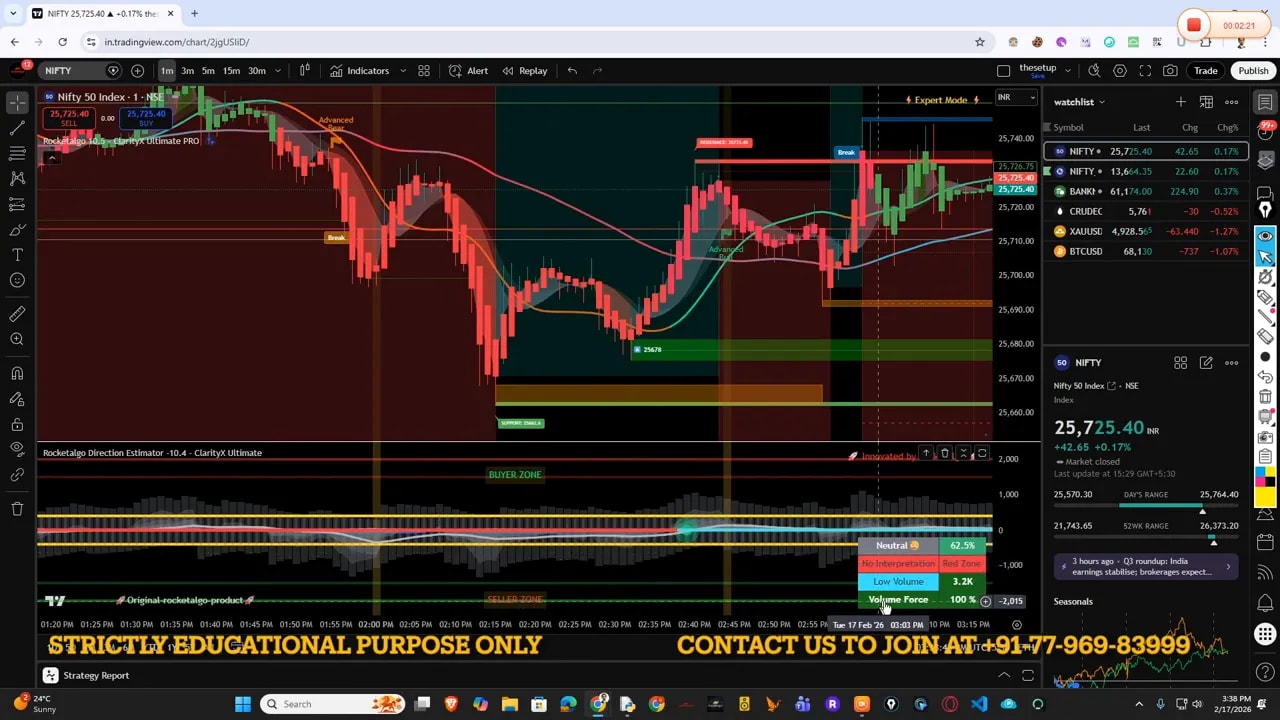
The screenshot above shows the Volume Force label appearing in the corner of the chart. That label updates as the session progresses and displays a live percentage. Think of this as a momentum meter for participation, not just price movement.
⚖️ Reading the signals: green, red, and gray zones
Volume Force uses a simple color language:
- Green: Buy-side force. Price is more likely to move up if other conditions allow.
- Red: Sell-side force. Downside momentum is dominant.
- Neutral/Gray: Low or mixed force. Market could be sideways or indecisive.
A green candle alone does not equal a buy. A green candle with green Volume Force above, say, 40 to 50 percent carries a very different probability profile than one with 3 or 5 percent volume force. The numerical percentage matters.
In the screenshot above the Volume Force is rising into the 40s. Price shows nominal upward movement even though resistance prevented a decisive breakout. That’s exactly the scenario where Volume Force helps: it identifies the push even when price is temporarily stuck by overhead supply.
🧭 How traders use Volume Force on NSE and BSE instruments
Use Volume Force to:
- Filter entries — only take trades where direction and force match your edge.
- Manage exits — reduce size or tighten stops when force wanes or flips color.
- Size positions — increase size slightly when force is both strong and persistent; decrease when it’s weak.
For Nifty and Bank Nifty intraday strategies, the addition of Volume Force can turn many marginal setups into actionable trades. For BSE stock swing trades, force helps distinguish between a low-volume breakout and a real institutional move.
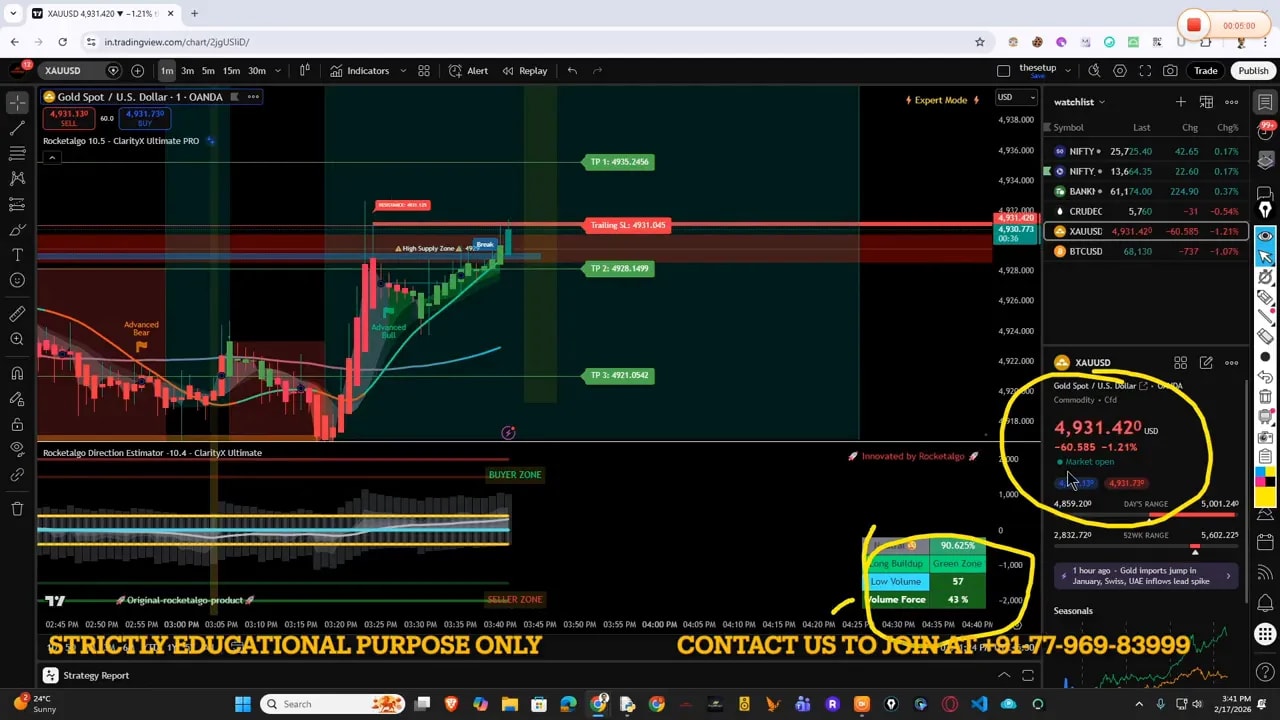
The image above demonstrates a clear case where Volume Force exceeded 50 percent and price followed up with stronger candles. This is the kind of confirmation many traders look for before committing capital.
🛠 Practical rules for live execution
Clear rules reduce hesitation and emotional mistakes. Here are practical, repeatable rules that combine direction, Volume Force, and risk control:
- Entry rule: Enter long when direction is bullish and Volume Force is green above 30 percent. Enter short when direction is bearish and Volume Force is red above 30 percent.
- Confirmation candle: Prefer entries on a confirmation candle that follows the initial signal — a closing candle in the signal direction.
- Stop placement: Use recent structure — low for longs, high for shorts — or ATR-based stops for volatility adjustment.
- Trend filter: Avoid counter-trend trades unless Volume Force is extremely high and supported by higher timeframe trend.
- Scaling: Scale in if Volume Force strengthens after your entry; reduce or close when force declines or flips color.
These rules are meant to be simple so they can be applied consistently across NSE and BSE instruments, whether you are day trading Nifty or swing-trading midcaps.
📉 Interpreting mixed signals and false starts
Markets are noisy and not every Volume Force spike leads to a big move. Common scenarios and how to respond:
- High Volume Force but price stuck at resistance: This may indicate accumulation below resistance. Wait for a breakout candle or use tight risk to catch the breakout.
- Volume Force spikes then collapses: That’s a warning sign. Consider partial exits or stop tightening.
- Direction and Volume Force disagree: Avoid trade or take a small, exploratory position with tight stops until alignment returns.
The point is not to eliminate loss but to increase the probability of positive outcomes while keeping risk controlled.
🔁 Integrating Volume Force into existing systems
You don’t need to throw away your current setup. Volume Force is an amplifier, a filter, and a decision aid. Here’s how to integrate it without overcomplicating:
- Keep your existing trend and structure rules.
- Use Volume Force as a confirmation layer before increasing size.
- Run a short backtest on your most traded setups with an added Volume Force threshold to measure improvement.
If you currently rely on indicators that only show direction, add Volume Force to reduce false positives. If you already pay attention to volume, this automation turns subjective interpretation into clear percentages.
💡 Real-world example: Nifty intraday move
Imagine Nifty is grinding higher but failing breakout at a known resistance. Direction is bullish but price stalls. Volume Force turns green and climbs to 40–50 percent. That tells you institutions are still buying behind the scenes. A planned entry on a breakout or a pullback with a manageable stop can convert that latent energy into a good trade.
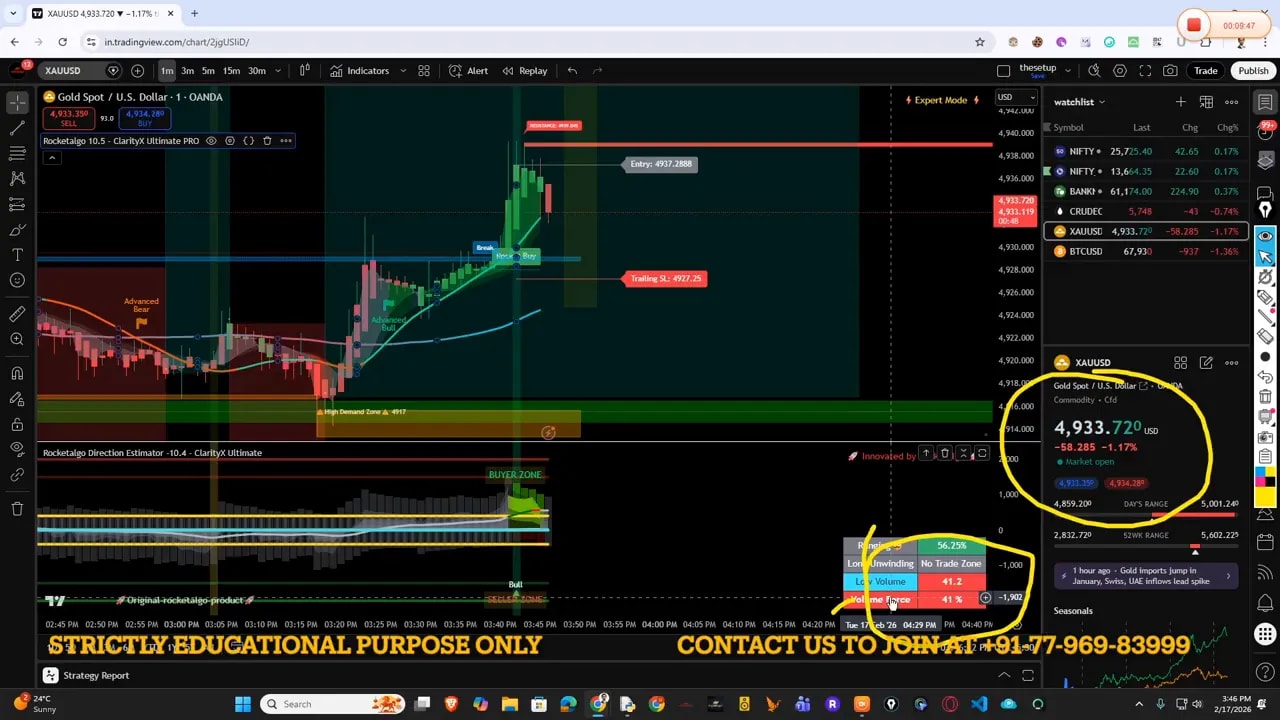
The screenshot shows a red-to-green flip and how Volume Force identifies the transition of control. Watching this transition in real time helps you enter with conviction rather than hesitation.
🚨 Risk management and psychological notes
Even the best signals fail sometimes. Here are reminders to trade responsibly:
- Position sizing based on volatility and account risk. Don’t let a perceived high-probability signal push you to over-leverage.
- Cut losses quickly when Volume Force flips color or collapses.
- Keep a trading journal that notes Volume Force percentage at entry and outcome. You’ll spot patterns across NSE and BSE instruments.
- Separate analysis from execution. The Volume Force signal is a tool — not a guarantee.
📊 Backtesting and performance habit checklist
To know if Volume Force improves your edge, run a disciplined test:
- Select a set of symbols you trade on NSE and BSE.
- Define the baseline setup without Volume Force.
- Add a Volume Force filter (for example, only take trades when force is > 30 percent and matches direction).
- Compare win rate, average return per trade, drawdown, and risk-adjusted return over a sample period.
Many traders find that a simple filter like this reduces noise and increases the reward-to-risk profile even if the win rate shifts slightly.
🔖 Keywords to keep in mind for your strategy
Use these keywords when documenting your plan or optimizing for SEO and market search queries:
- trading, stock market, NSE, BSE, Nifty
- Volume Force
- directional setup
- probability edge
- position sizing
- risk management
❓ Frequently Asked Questions
What exactly is the Volume Force percentage showing?
It is an estimate of how strongly volume is pushing in the detected direction. Think of it as an energy meter: higher percentage means more participation behind the move. Use it as a probability enhancer, not a silver bullet.
Can Volume Force be used on both NSE index futures and BSE stocks?
Yes. The logic applies to any liquidity pool where volume represents market commitment. For less liquid BSE small-caps, interpret readings with caution and adjust thresholds lower to avoid false signals.
What threshold should I use to take trades?
A common starting point is 30 percent. Many traders increase confidence at 40–50 percent. Backtest on your specific symbols and timeframes to find the best threshold.
Does Volume Force replace other indicators?
No. It complements directional and structural analysis. Use it as a filter and confirmation tool rather than a standalone signal.
🧾 Final checklist before you trade
- Direction and Volume Force align (same color).
- Volume Force percentage meets your threshold.
- Entry has a defined stop and target or a clear exit plan.
- Position size matches risk rules for your account.
- Trade plan recorded in your journal for later review.
Adding one clean filter like Volume Force to your process can remove many marginal trades and concentrate capital on better opportunities. Whether you trade Nifty intraday, Bank Nifty, or individual BSE stocks, the same principle helps: follow direction, confirm with participation, control risk.
If you adopt this approach, keep iterating. Markets evolve and edges degrade when everyone copies them. Use Volume Force as a disciplined tool, not a shortcut to overconfidence. Trade with respect for risk and the markets; the reward follows discipline.
Need more help
Contact us by clicking the button below

